Why does the world need BinderVerse?
Wet-lab data is both the final judge of and the bloodline for AI in biology. In the context of protein design, especially binder design, the need for data manifests as the need to quickly turn digital amino acid sequences to physical protein molecules, and then to functional readouts, all with manageable cost and high data quality. While many conventional CROs and emerging cloud labs try to fill this gap, the service that checks all boxes remains elusive.
The challenge seems trivial but is also understandably stubborn. Roughly half of the cost in the sequence-to-function conversion lies in gene synthesis, whose cost has not dropped meaningfully since the mid-2010s. The service must also be agile, in terms of both science and business. On the bench, different binder formats (e.g., minibinder, VHH, antibody) require different optimal expression and purification protocols, and different target formats (e.g., monomeric, dimeric, Fc-fusion) require different assay protocols on the bio-layer interferometry (BLI) or surface plasmon resonance (SPR) instruments. One-size-fits-all rarely works in wet-lab experiments. On the computer, the user interface (and ideally, agent interface) to validate protocols, parameterize quotes, make payments, track progress and visualize data must also live up to the efficiency standard of the AI age. The seamless and error-free software/hardware/wetware connection demands interface engineering far beyond typical lab operations.
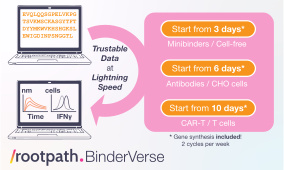
This is exactly why we created BinderVerse™ at RootPath. We bring our unmatched capability in fast and high-throughput gene synthesis, years of hands-on experience in biologics drug development, and commitment to a frictionless human/agent-lab interface to the cloud lab format, offering you the fastest, most affordable AND highest-quality binder functional testing, letting you turn amino acid sequences to functional data in as short as 3 days.
What BinderVerse offers
Binders come in all shapes and sizes, and are intended to be used in different formats, so BinderVerse does not force every project through one workflow. Currently we offer four protein expression systems:
- Cell-free protein synthesis (E. coli lysate-based, Fig. 1a)
- Mammalian secretory protein expression for full-length antibody expression (CHO/293-based, Fig. 1b)
- Mammalian secretory protein expression for Fab fragment expression (CHO/293-based, Fig. 1b)
- Human T cell membrane expression for CAR-T (Fig. 1c)
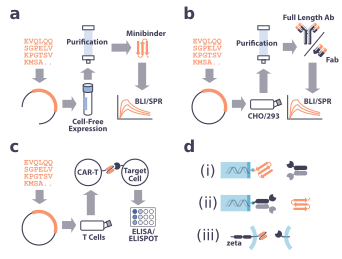
For cell-free and mammalian secretory expression, we produce the binder protein as a soluble protein, with optional purification steps, and we offer biophysical binding assays using BLI and SPR. You can choose between immobilizing the binder (Fig. 1d.i) or immobilizing the target (Fig. 1d.ii).
For human T cell membrane expression, we produce the binder as a CAR construct on the surface of donor-derived human primary T cells, with several popular transmembrane domains and co-stimulatory domains for you to choose from, and offer cell-based cytokine secretion (e.g., IFN$\gamma$) and T cell activation (e.g., surface CD137 expression) assays.
Cell-free protein synthesis and testing
For minibinders generated with framework-less hallucination-based processes (e.g., RFdiffusion/ProteinMPNN, BindCraft) or similarly-sized binders with 0 or 1 disulfide bond, we recommend E. coli-based cell-free protein synthesis (CFPS) featuring a blazing fast turnaround time (TAT, Fig. 1a). Because of the small size of these proteins, the quality of non-clonal gene fragments is usually high enough. This allows super fast gene synthesis: 2 days starting from confirming the order. CFPS is similarly fast and BLI/SPR can be completed soon after, making total sequence-to-function time a record-low 3 days.
Two notes affecting turnaround time
- Order cut-off time: Currently we initiate two fulfillment cycles per week, with order confirmation deadlines at 09:00 UTC on Friday and Tuesday. In the future, if the demand grows, we expect to initiate a fulfillment cycle on each weekday.
- Gene synthesis capacity: Currently, our fast synthesis (2-day TAT for gene fragments and 4-day TAT for plasmids) has a capacity of ~100 minibinder/VHH-sized genes or ~50 antibody-sized genes per cycle. We will notify you how much capacity is still available when you order. In case of excess demand, you can choose to enter the queue for upcoming cycles. Meanwhile, our high-throughput gene synthesis (2-week TAT for gene fragments and 3-week TAT for plasmids, at a lower cost) runs 1 cycle per week and has a capacity of >2,000 minibinder/VHH-sized genes or >1,000 antibody-sized genes per cycle. So even in the worst-case scenario, your wait time is no more than 2-3 weeks beyond the optimal time.
Full-length antibody and Fab fragments
While the small size and the disulfide-free nature of minibinders make them great candidates for cell-free protein synthesis, antibodies and antibody fragments are a different proposition. A human IgG1 carries sixteen disulfide bonds and has to assemble from four separate polypeptides; even an scFv has two intra-domain disulfides plus the much harder problem of getting its VH and VL domains to structurally align into a native conformation. Mammalian secretory expression in CHO or 293 cells remains the gold standard here, because the ER provides an oxidizing lumen, resident chaperones and disulfide isomerases, and a quality-control system that retains and degrades misassembled chains instead of secreting them. The protein that comes out of the supernatant has already passed a folding checkpoint.
We offer full-length antibody expression and Fab fragment expression at two scales (Fig. 1b). The default is a 1 mL culture, which gives enough material for BLI and SPR and keeps the cost per binder low. It is the right choice when you are ranking tens of candidates. For deeper characterization we run 30 mL cultures with purification, which yields milligram quantities, supports SEC and other QC, and lets us ship the purified protein to you for additional testing.
Between full-length antibodies and Fab fragments, the latter is our default recommendation for affinity measurement since it is monovalent. We also prefer Fab fragments over scFvs since the constant domains hold VH and VL in the correct relative orientation (see this post for a deeper discussion). On the other hand, full-length IgG is the right call when you are ready to test effector function, FcRn interaction or developability on the exact molecule you measured binding on.
VHH, thanks to its small size and disulfide-light nature, can be successfully expressed in both cell-free and mammalian systems, giving you the highest flexibility.
CAR-T
We are particularly excited to offer CAR-T function testing with a turnaround time of about 10 days. This service grew out of our deep expertise in a decade of T cell research and drug development, and can be viewed as an extension of our TCR functional screening service TCR Decoder™ (also see this post to learn more). In particular, we replaced the conventional lentivirus-based CAR-T and TCR-T cell production procedure with a much faster mRNA-based method. The conventional lentiviral route takes about 1 week to synthesize the genes, 1 week to produce the viral particles and another 1 to 2 weeks to produce CAR-T or TCR-T cells, before activation assay can be conducted. In contrast, our method takes 10 days total, including gene synthesis, plasmid clonal selection, mRNA production, CAR-T or TCR-T production and functional testing.
The CAR-T assay answers a question no biophysical measurement can: does this binder, presented on a cell surface at physiological geometry, drive a T cell to respond to a cell that displays the target? Affinity is only one input to that answer. Epitope position relative to the membrane, target density, and the resulting synapse geometry all matter, and they can reorder a ranking derived from $K_\text{D}$ alone. The full workflow, and why mRNA changes the timeline, is the subject of its own post.
Choosing the binding assay orientation
Every biophysical binding assay can be run in either orientation with regard to which molecule is immobilized (Fig. 1d, i and ii), and the choice is not cosmetic. Immobilizing the binder is cheap in material and does not require you to know what fraction of your protein is correctly folded. But if your target is an Fc-fusion, or is otherwise dimeric, a densely loaded binder surface lets one target molecule bridge two binders, and the apparent affinity can come out orders of magnitude tighter than the true value. Immobilizing the target removes that artifact at the cost of needing a known, well-folded binder concentration. We think this is the single most common way a binder campaign gets misled, so we devoted a whole post to it.
Sequence in, function out, trustable data at lightning speed
Four expression systems, three assay orientations, and one set of hands and robots from gene design to delivered data. Minibinders go from amino acid sequence to binding curve in 3 days, Fab and full-length antibodies in about 6, and CAR-T functional data in about 10, including the time for gene synthesis.
Data Security Pledge
Your data is yours. We keep it confidential and do not use it in any asset development or model training.
If you are designing binders and want to find out what your designs actually do, take a look at BinderVerse™, email me at [email protected], or book an online meeting. We would love to put your designs on the bench.
– Xi Chen