Most binding assays nowadays require a solid surface, onto which one of the two binding partners is immobilized. This leaves us with two natural choices: immobilizing the target protein or immobilizing the designed binder. The choice between the two on the surface (no pun intended) appears to be symmetrical and equivalent. However, in many cases the choice has important implications and the wrong choice may lead to grossly overestimated affinity.
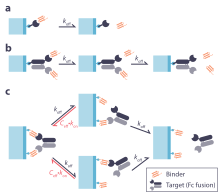
Figure 1. Dissociation pathways for monovalent and divalent binding. (a) Dissociation of a monomeric binder with dissociation rate constant $k_\text{off}$. (b) The Fc-fused target protein is immobilized on the surface; the monomeric binder binds the target protein. Each arm of the dimer is occupied independently, and each bound binder dissociates at the intrinsic rate $k_\text{off}$. (c) The monomeric binder is immobilized densely on the surface, allowing one Fc-fused target molecule to engage two neighboring binders at the same time. To dissociate from the surface, both arms must release before either one rebinds, and a dangling arm returns to the surface at an effective rate $C_\text{eff} \cdot k_\text{on}$, where $C_\text{eff}$ is the effective local concentration of binder within its reach.
The simple rule-of-thumb to measure affinity is: the binding partner in solution must be monovalent. Now let’s unpack this.
The simple model of dissociation is shown in Fig. 1a, where both the binder and the target are monomeric. In this case, the fraction of the target (dark navy) that is bound by the binder (orange), written as $F_\text{B}$ decreases in the dissociation phase of the BLI/SPR experiment with single exponential kinetics:
$$ F_B = F_{B0}\cdot e^{-k_\text{app}\cdot t} \tag{1}$$where $F_\text{B0}$ is $F_\text{B}$ at the beginning of the dissociation phase, $k_\text{app}$ is the apparent decay constant, which equals $k_\text{off}$ in this simple case.
For various practical reasons, many target proteins of mammalian origin, especially secreted proteins or the ectodomains of transmembrane proteins, are only available in soluble form as Fc fusions. In this case, if the target protein is immobilized on the surface, and the binder is monomeric (Fig. 1b), in the dissociation phase each binder protein can still dissociate from the target independently, and $k_\text{app}$ still equals $k_\text{off}$ in Eq. 1.
However, if the binder is immobilized, then an interesting situation shown in Fig. 1c may occur. The two copies of the target protein (dark and light navy) may find two copies of the binder on the surface simultaneously. For the target-Fc fusion to dissociate, one of the copies must dissociate from its binder locally to form the ‘dangling intermediate’. From this point, the other copy must also dissociate for the BLI/SPR instrument to register a signal loss. However, the dangling intermediate can rebind to become the bivalently bound form with a rate constant of $C_\text{eff}\cdot k_\text{on}$, where $C_\text{eff}$ is the effective local concentration of binder that a dangling arm can reach, i.e., the number of binders inside the small volume the arm sweeps, divided by that volume. In this situation, the measured $k_\text{app}$ becomes:
$$ k_\text{app} \;\approx\; \frac{2k_\text{off}^2}{C_\text{eff}k_\text{on}} \;=\; k_\text{off}\cdot\frac{2K_\text{D}}{C_\text{eff}} $$An Fc hinge gives the free arm a reach on the order of 10 nm. If neighboring binders also sit within 10 nm apart, the arm has a partner or so within a volume of roughly $10^{-21}$ L, which is a few millimolar. Against a $K_\text{D}$ of 10 nM, the suppression factor $2K_\text{D}/C_\text{eff}$ comes out near $10^{-5}$, so the measured off-rate can be four to five orders of magnitude too slow. Of course in reality the $C_\text{eff}$ may not be as high as this estimate, since rebinding is often conformationally constrained. But it’s common to find $k_\text{app}$ 1 to 2 orders of magnitude lower than the true $k_\text{off}$.
One may argue that this can be relieved if the loading of the binder on the surface is sparse, ensuring that, for the most part, the two nearest copies of the binder protein are far enough away from each other that this bivalent binding does not happen. However, it is difficult to establish a protocol to ensure this, especially when the fraction of well-folded binder protein is low and unknown. I have written this accompanying post to further explain this point and to lay out the pros and cons of immobilizing the target versus the binder for different situations.
I’m sure many of you are already well versed in this avidity caveat in binder testing, but if you are not I hope this post can clear up some confusions. On BinderVerse™ both orientations are available for every biophysical workflow. If you are still not sure which configuration your target calls for after reading the accompanying post, feel free to email me at [email protected] or book an online meeting and we will work it out together.
– Xi Chen